


Breaking Free From All Or Nothing Thinking-

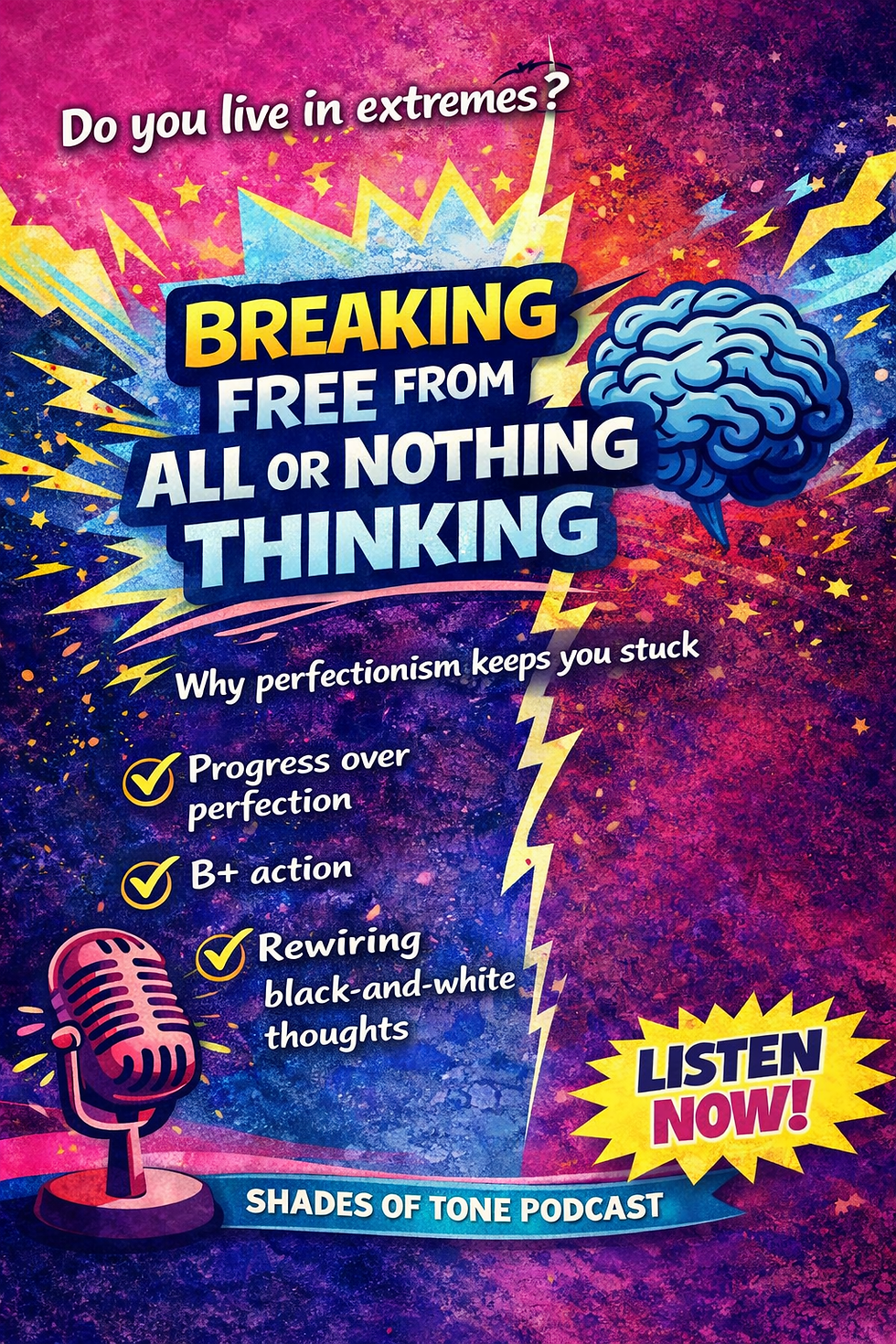
All or nothing thinking sneaks in quietly, often disguised as high standards or discipline, then turns everyday slips into verdicts on who we are. At its core, this is a cognitive distortion that flattens life into extremes: success or failure, good or bad, on track or off track. When nuance disappears, compassion goes with it. The result is a fragile sense of progress that shatters the moment reality fails to be perfect. Many listeners recognize the pattern: one unplanned snack becomes a binge, one missed workout becomes a lost week, one distracted day becomes a story that we’re not serious. The tragedy isn’t the slip; it’s the story the slip becomes. And that story drains motivation, identity, and resilience.
Psychology names this distortion black and white thinking, or dichotomous thinking. Research in cognitive behavioral therapy shows that people who think this way experience more emotional distress and greater shame responses after setbacks. Shame is especially corrosive because it turns a solvable problem into a personal flaw; the nervous system reads a minor mistake as total failure and hits the shutdown button. When effort equals worth, mistakes become identity statements. Instead of “I missed once,” it becomes “I am a failure.” That internal collapse explains why consistency feels impossible. The issue isn’t laziness; it’s the inability to recover without self-attack.
Where does this pattern come from? Often from environments where praise was conditional, performance was king, and mistakes carried social or emotional costs. High-pressure schools and homes, competitive teams, and productivity-first workplaces teach a simple rule: being good keeps you safe. The brain, brilliant at survival, codifies that rule into a rigid system. Over time, it expands beyond grades or sports and bleeds into food, fitness, relationships, and work. We stop making adjustments and start making judgments. A plan becomes a pass-fail test, and we forget that skill grows in gradients, not leaps.
To rebuild resilience, we have to reintroduce the middle. That means separating events from identity and switching from outcome-only evaluation to process evaluation. Instead of measuring worth by flawless execution, measure by “repair speed” and “skillful next step.” One helpful reframe: consistency isn’t the absence of mistakes; it’s the speed and kindness of your repair after mistakes. This shift trains the nervous system to see slips as signals, not sentences. Ask: What made this hard? What tiny action would put me back in motion today? What would I do if I wasn’t ashamed? The answers are usually small, doable moves that restore momentum.
Practically, build “graceful defaults” that prevent zero days. If a 45-minute workout falls through, a 5-minute walk still counts. If cooking fails, choose the most balanced takeout you can. If focus is gone, set a 10-minute timer and close one loop. Design plans with flexible rungs so you can step down without falling off. Then, pre-plan recovery scripts: After a miss, I will name the trigger, normalize the human moment, choose a smallest next step, and log the repair win. This isn’t lowering standards; it’s changing the standard from perfection to persistence.
Finally, track identity shifts: I am someone who returns quickly. I am someone who treats mistakes as information. Identity follows repeated proof. Over weeks, your nervous system learns that safety doesn’t depend on being perfect; it depends on being adaptive. When the middle is available, the extremes lose their grip. Progress becomes durable, motivation steadier, and self-respect no longer conditional. You don’t need a flawless streak. You need a friendly reset button and the courage to press it often.


Comments